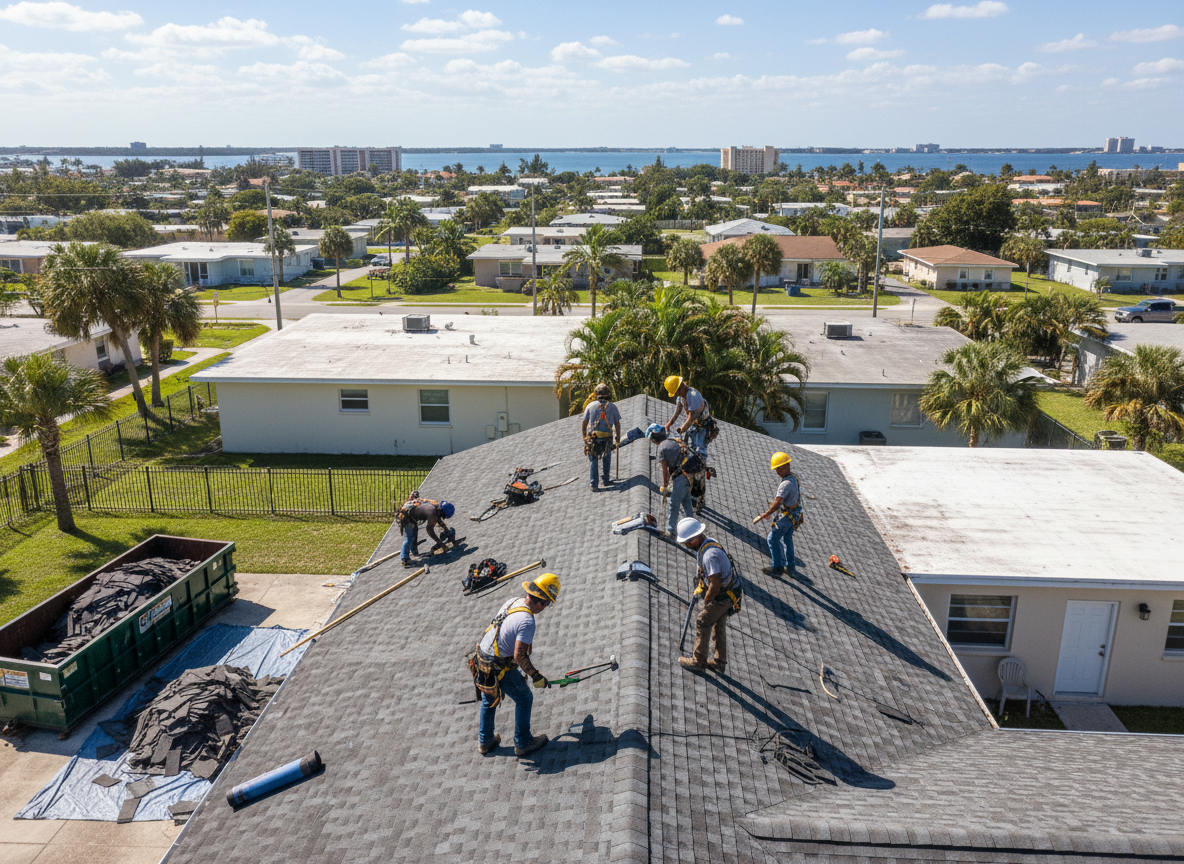
A ridge of shingles lifted in last week's storm, and now two contractors have given you two different answers. One says patch it. The other says Florida law forces a whole new roof.
For many homes, the honest answer depends on a date most people never check: the year the roof was permitted. That date decides how much of your roof has to meet today's code.
Our roof repair Tampa service starts there, so you pay to fix the damage you have and nothing you do not need. If water is coming in, emergency repair comes first.
Why Homeowners Choose Roof Repair Tampa FL for Roof Damage Repair
Most roof repair quotes tell you what is broken. Ours also tells you what the rules say about fixing it.
Before we quote any residential roof repair, we look up your roof's permit history and measure how much of the roof or roof section is damaged. That tells us whether a partial repair is allowed or whether the code pushes the job toward replacement.
That matters because roof damage repair in Florida is not only a materials question. A repair that covers 25 percent or more of a roof section is treated differently depending on when the existing roof was built. We explain which side of that line you are on, in writing, before you sign anything.
You also get a straight answer when a repair is the wrong spend. If decking is soft across a wide area or the roof is near the end of its life, we will say so, and show you why with photos. When a repair is the right call, we fix it and stop there.
What every roofing repair from us includes:
- A roof inspection with photos of each damaged area, so you can see what we saw.
- A written scope that names the roof system, the materials and the area being repaired.
- A check of your roof's permit date against the 2007 Florida Building Code line.
- A plain answer on whether your job needs a permit, and who pulls it.
- A note on anything we saw that is not urgent, so you can plan instead of being upsold.
We also work on commercial and rental buildings, where an owner usually needs a scope a property manager or insurer can follow. The same 25 percent rule applies to a commercial roof section as to a house.
Why Emergency Roof Repair Should Not Wait for the Next Storm
A small opening in a roof does not stay small in this climate. Water that gets past a lifted shingle or a cracked boot reaches the underlayment, then the decking, then the ceiling. Wet decking softens, fasteners lose their grip, and the next strong gust has more to pull on.
Timing here is driven by the weather calendar. The National Weather Service treats June 1 through September 30 as the rainy season for this region, and the 1991 to 2020 normals at Tampa International Airport put August at 9.03 inches of rain.
Atlantic hurricane season runs June 1 through November 30. A roof that is opened up in spring can take months of daily afternoon storms before anyone sees a stain.
There is also a paperwork clock. Under current Florida law, a new property insurance claim generally has to be noticed to the insurer within one year of the date of loss.
Waiting to see if a leak gets worse can use up that window. The rule has changed before, so confirm the deadline in your policy with your agent.
When you call about emergency roofing, we ask what you can see and whether water is coming in now. If it is, the first job is to stop it with a temporary cover, then plan the permanent repair.
Emergency roofing services exist to protect what is under the roof while a proper fix is scheduled, not to rush you into one. The same applies to emergency commercial roof repair, where the first job is protecting tenants and stock.
Proof You Can Check Before You Call Anyone
We are not going to show you star ratings or badges. We would rather you check facts that do not depend on what any roofer says about themselves, including us.
- Licensing. Florida licenses roofing contractors under Chapter 489. A Certified Roofing Contractor license is valid statewide, and you can look up any contractor at MyFloridaLicense.com before you let them on your roof. Florida law does not leave roof work to an unlicensed handyman, and you should not either.
- Permits inside city limits. The city has listed roof covering repairs of 500 square feet or less as work that does not need a building permit, while noting its guidance can change. Larger repairs and re-roofs are permitted and inspected. We confirm with the permitting office for your address, since some homes fall under the city and others under Hillsborough County.
- County re-roof inspections. Hillsborough County's re-roof process includes a Progress Check inspection, where inspectors confirm roof attachments are strengthened as the Florida Building Code requires, before the final.
- The 25 percent rule and its exception. Section 553.844(5) of the Florida Statutes is public. You can read it yourself.
If a contractor's answer to your roof does not line up with these sources, ask them why.
When a 1970s Roof Section Is 30 Percent Damaged: Repair or Replace?
Much of north Tampa was built in the 1960s and 1970s. Census data puts the median year built for homes in ZIP 33617 at 1979, so many of these houses have had two or three roofs. That history is exactly what decides your next repair.
Here is a common situation. A storm strips shingles across about a third of one slope. Under the Florida Building Code's existing building rules, not more than 25 percent of a roof or roof section can be repaired, replaced or recovered in a 12-month period unless the whole roof system is brought up to current code.
A 2022 law, Senate Bill 4-D, changed that for newer roofs. If your existing roof was built, repaired or replaced to the 2007 Florida Building Code or a later edition, only the part being repaired has to meet the code in effect, even when that part is 25 percent or more. Local governments are not allowed to amend that exception.
The catch is the date. The 2007 code did not take effect until March 1, 2009, so a roof permitted before then may not qualify, and the general 25 percent rule may still apply. Interpretations continue to shift, so we pull the permit record rather than guess.
So two homes on the same street with the same storm damage can get different, correct answers. One gets a section repair. The other is looking at a full re-roof.
We show you which case you are in, and why, before quoting either. If replacement is the answer, our full roof replacement service picks up from the same inspection.
Commercial roofing repair follows the same logic. A low-slope roof section on a small commercial building, or a duplex roof split into sections, is measured and dated the same way.
Storm Damage Roof Repair After Hurricane and Wind Events
Wind does not need a direct hit to damage a roof. During Hurricane Milton in October 2024, the National Weather Service recorded gusts generally between 80 and 100 mph across Hillsborough County, with a maximum gust of 93 mph near Tampa International Airport.
Rain totals ran 10 to 15 inches across most of the county. Helene had come through two weeks earlier.
Storm damage often hides. Shingles can lift, crease and reseal so they look flat from the street while their seal strip is broken. Ridge caps loosen.
Flashing bends back just enough to let wind-driven rain in sideways. Severe thunderstorms can also bring hail, so hail damage roof repair means checking for bruised shingles and dented metal too.
Our storm damage repair process:
- Stop active water first with a temporary cover if needed.
- Photograph every slope, including creased shingles and lifted ridge caps.
- Measure the damaged area per roof section and check the permit date.
- Write a scope that separates storm damage from normal wear.
- Repair, then photograph the finished work for your records.
Commercial storm damage roof repair follows the same steps, with sections measured for the owner and any insurer.
Roof Systems We Repair
Shingle Roof Repair
Asphalt shingles are the most common roof covering in Florida. A state roofing association estimate puts them at about 65 percent of roofs statewide. A shingle repair replaces damaged shingles and reseals the course around them so wind cannot lift the new ones.
The value is scope: a targeted shingle roof repair is a far smaller job than a new roof when the deck and the rest of the field are sound. It also helps you decide whether the roof can last until you are ready to plan a replacement.
Watch for creased tabs, missing granules collecting in your gutters, and nail heads backing out. Your next step is simple: after the next windy day, photograph each slope from the ground and compare it with older photos.
Tile Roof Repair
Concrete and clay tile roofs are built in two layers. The tile sheds most water and protects the underlayment beneath it from sun. The underlayment is what actually keeps the house dry.
Tile roof repair usually means replacing cracked or slipped tiles and resealing or replacing the underlayment where water has reached it. The commercial value is that a sound tile field can often be kept rather than replaced. That supports a decision between a tile-for-tile repair and a larger underlayment project.
Matching older tile can be hard, so ask early whether spare tiles exist. Never walk on a tile roof yourself, because tiles crack under foot. Your step is to check the garage or attic for leftover tiles from the original job.
Metal Roof Repair
Metal roofs come in two main types: exposed-fastener panels, where screws go through the face of the panel, and standing seam, where the fasteners are hidden under raised seams. Most metal roof repair involves fasteners and the rubber washers under them, which age in strong sun, plus sealant at trim and penetrations. The value is lifespan.
A metal roof with failing screws is often a maintenance job rather than a replacement. A proper inspection tells you whether you need a fastener program, a panel swap, or a seam repair.
Your immediate action is to look at the screw heads from a ladder at the eave. If washers are cracked or screws have backed out, book an inspection before the next storm.
Flat Roof Repair
Low-slope and flat roofs, common on additions, porches and commercial buildings, use membranes such as modified bitumen, TPO or EPDM instead of shingles. They drain slowly, so ponding water finds every weak seam. Flat roof repair usually means patching or reseaming the membrane and correcting drainage at scuppers and drains.
The commercial value is avoiding interior damage on a roof you rarely see. A membrane inspection supports the decision between patching, recovering, or replacing the section, and the 25 percent rule applies to roof sections here as well.
After a heavy rain, check whether water is still standing on the roof two days later. If it is, note where, take a photo, and include it when you request an inspection.
Book a Roof Repair Inspection
Tell us what you are seeing: a lifted shingle, a stain on the ceiling, storm damage on one slope. We will inspect, photograph every problem area, check your roof's permit date, and give you a written repair scope that says whether the job is a repair, a permitted repair, or a replacement conversation.
If water is coming in now, say so when you call and we will start with stopping it. For a stain that keeps coming back, see our roof leak detection and repair, and if overflowing gutters are soaking your fascia, see our gutter cleaning service.
Call Roof Repair Tampa FL at (813) 547-8189, or visit us at 13301 Arbor Pointe Cir, Tampa, FL 33617.
Roof Repair Services We Offer
✓Storm Damage Roof Repair
Repairs after wind, hurricane and severe thunderstorm damage: temporary cover first if water is coming in, every slope photographed, damaged area measured per roof section against the permit date, then a written scope that separates storm damage from normal wear.